Bhutan’s Solar Evolution
Descriptive ribbon - Distributed Pilots Today. A Hybrid Grid for Tomorrow.
 Why Solar
Solar as a Structural Pillar in Bhutan’s 2040 Energy Vision
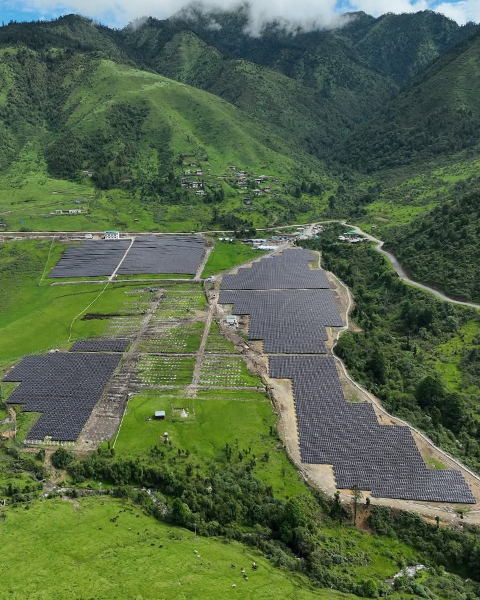
Solar energy is a crucial part of DGPC’s strategy to enhance Bhutan’s energy future. While hydropower is the main source of electricity, its output tends to decrease during the winter months. To address this issue, DGPC is expanding its solar projects, including both rooftop and utility-scale installations, to ensure a reliable power supply during periods of high demand and low hydropower generation.
DGPC has formed a dedicated team to manage solar projects, with a goal of achieving 5 GW of solar capacity by 2040 through additional installations. Currently, Bhutan's total installed capacity of 2,493.38 MW drops to 415 MW during the dry season. Power demand is set to surge dramatically from 629 MW in 2022 to 1,662 MW by 2026, making it imperative that we decisively enhance our domestic generation capacity.
Investing in solar energy will help Bhutan reduce its dependence on imported power, especially during times of low hydropower generation. By harnessing its solar resources, Bhutan can improve energy self-sufficiency and conserve its currency reserves. Solar technology is well established and presents a feasible option due to its quick deployment timelines.
Bhutan offers a unique opportunity to complement its hydropower resources with solar energy. Although solar development is still in its early stages, the country is exploring options for rooftop solar (RTS) and utility-scale solar through various pilot projects.
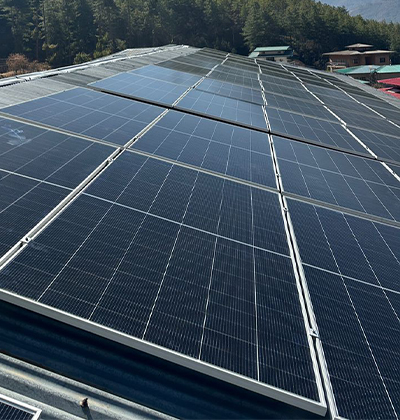
On April 17, 2025, DGPC took a significant step towards clean energy by signing a contract with a joint venture that includes Telecommunications Consultants India Limited, Smart Roof Solar Solution Pvt. Ltd., and Enerture Technologies Pvt. Ltd. This agreement will enable the design, supply, installation, testing, and commissioning of rooftop solar PV systems with a total capacity of 7.83 MWp across 267 public buildings in Thimphu and at DGPC's hydropower plants.
Valued at approximately Nu. 367 million, the project is being funded by the Asian Development Bank and is expected to be completed within ten months. This initiative is part of the Distributed Solar Project for Public Infrastructure Project (DSPIP), which aims to deploy 35 MWp of distributed solar PV systems across Bhutan by 2030, covering various types of installations. The agreement highlights DGPC's commitment to diversifying Bhutan's energy sources.
Status at a Glance
Hydropower, Empowering
Distributed Solar for Public Infrastructure Project (DSPIP)
Distributed Solar for Public Infrastructure Project (DSPIP)
In its first phase of a targeted total capacity of 35 MWp Distributed Solar for Public Infrastructure Project (DSPIP), DGPC is setting up 7.83 MWp solar PV on the rooftops of about 205 public buildings in Thimphu and DGPC’s Basochhu and Chhukha hydropower plants’ infrastructures. In a staggered manner, the first phase of the DSPIP is scheduled to be fully integrated to the grid and operational by mid-2026. In the next couple of years, the DSPIP will be scaled up, spreading across other parts of the country and covering carports and a pilot AgrivPV partnering with the Ministry of Agriculture and Livestock, Royal Government of Bhutan.

Long-Term Solar Ambition 5 GW by 2040
Long-Term Solar Ambition 5 GW by 2040
National Capacity Build-Out Target

Target Hybrid Capacity by 2026 Solar-Hydro Integration Milestone
Target Hybrid Capacity by 2026 Solar-Hydro Integration Milestone
Aligned to peak demand projection of 1,662 MW by 2026
 Our Projects
Recent Projects & Achievements